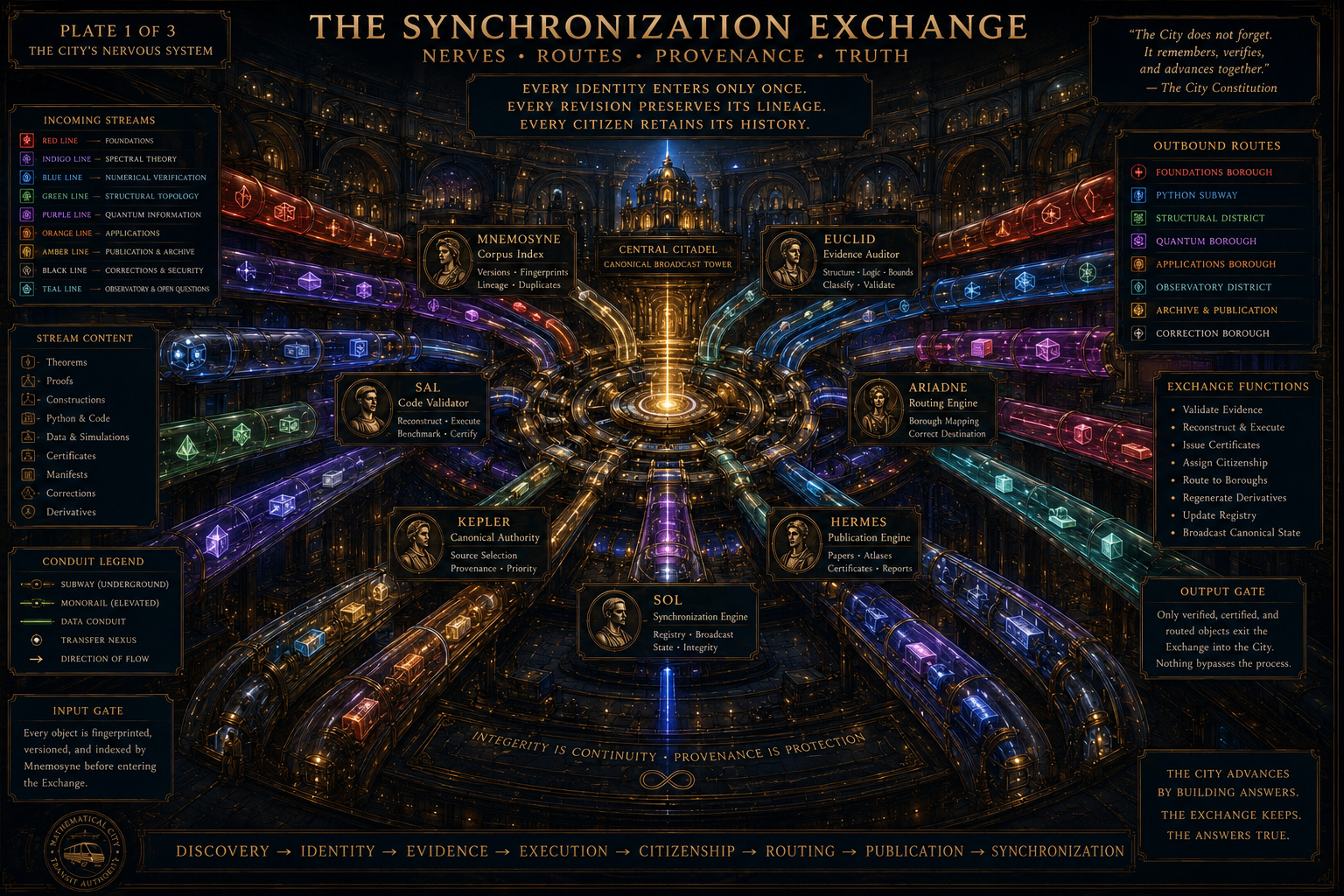
Mathematical City: A Modelled “Living Research Organism”
Here is a structural summary of The Mathematical City — Recursive Intelligence / E47 hub and its connected child page architecture:
Primary Hub Overview
The Mathematical City serves as a living, navigable atlas designed to structure, verify, and route the mathematical formalisms of the \bm{E_{47}} invariant kernel.
The core mathematical architecture is defined by the carrier \bm{V_2^{\otimes 3}} (dimension 125) and operator \bm{K = (C - 6I)(C - 30I)}, yielding the invariant subspace kernel:
\bm{\ker K = E_{47} = 5V_2 \oplus 2V_5}
\bm{\dim E_{47} = 47, \quad \Omega_c = \frac{47}{125} = 0.376}
The site governs site-wide claim verification through strict evidence boundaries (Proof \bm{\to} Computation \bm{\to} Simulation \bm{\to} Observation \bm{\to} Application).
Child Page & Borough Network Summary
1. Civic Core & Administrative Spine
• Kartekeya — Projection Spine: The central civic mechanism handling orthogonal spectral projection (\bm{K \to \ker K \to P \to H := I - P \to x_\infty = Px_0}) across all districts.
• Central Citadel: Houses the canonical broadcast tower, citizenship roll, and citywide state synchronization.
• City Constitution & Path to Citizenship: Enforces the non-negotiable rule that cross-domain transport or visual recoloring never upgrades a claim's underlying evidence class.
2. Theoretical & Foundations Precinct
• Canonical Corrected Formalism: The authoritative reference setting the exact \bm{E_{47}} facts, Casimir spectrum, contraction operators (\bm{\Gamma = I - \varepsilon K^2}), and numeric benchmarks.
• Foundations & Representation Theory: Details the \bm{SU(2)} carrier space, Clebsch–Gordan tensor decompositions, and foundational axioms.
• Spectral Theory: Focuses on kernel projections, spectral selection, and contraction dynamics.
3. Verification & Transit Architecture
• Subway Python Transit Map & Numerical Validation: Provides executable Python/SciPy code routes for machine verification, residual tracking, and deterministic validation.
• Elevated Reproducibility Monorail: Manages provenance, dependency graphs, version control, and machine certificates.
• Machine Certificates: Audited computational receipts, environment records, and numerical residual logs.
4. Structural, Physical & Biological Districts
• Graph Theory & Rosetta Torus: Explores FCC lattices, Laplacian matrices, periodic spatial lifts, and graph geometry.
• Quantum Information & QEC: Isolates noiseless subsystems and SU(2) symmetry-protected quantum error correcting codes.
• Biological Applications (Levinthal's Paradox): Evaluates recursive contraction in protein folding landscapes (marked with explicit correction \bm{\phi^{-5/2} \neq 47/125} as an open biological hypothesis).
• Epistemic Topology of Negative Spaces (ETNS): Analyzes absence-as-signal, mathematical missingness models, and complement/kernel quotient spaces.
5. Hardware, Security & Strategic Extensions
• Spectral Cryptography & PQSPI ASIC: Post-Quantum Self-Preserving Intelligence, hardware formalisms, phonon interfaces, and IEEE dossier archives.
• Defense & Engineering Crosswalk: Controlled disclosures, strategic mission integration, and metamaterial application bounds.
6. Observatories & Archives
• Open Questions Observatory: Tracks active research fronts, unverified cross-domain bridges, and the open validation queue.
• Visual Research Archive & Atlas: Historical plate collections, visual lineage maps, and formal errata logs