The Computational Universe
The Computational Universe
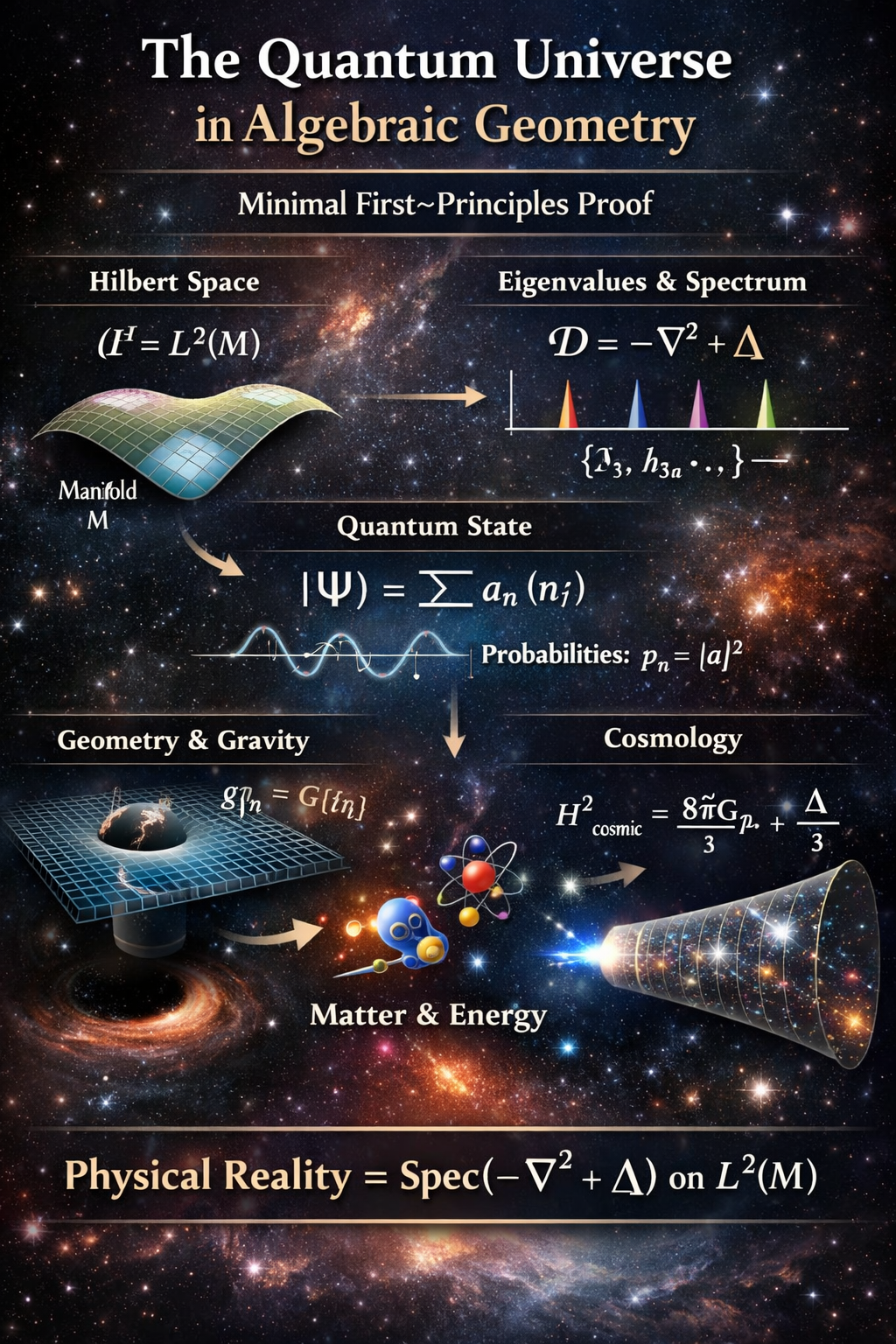
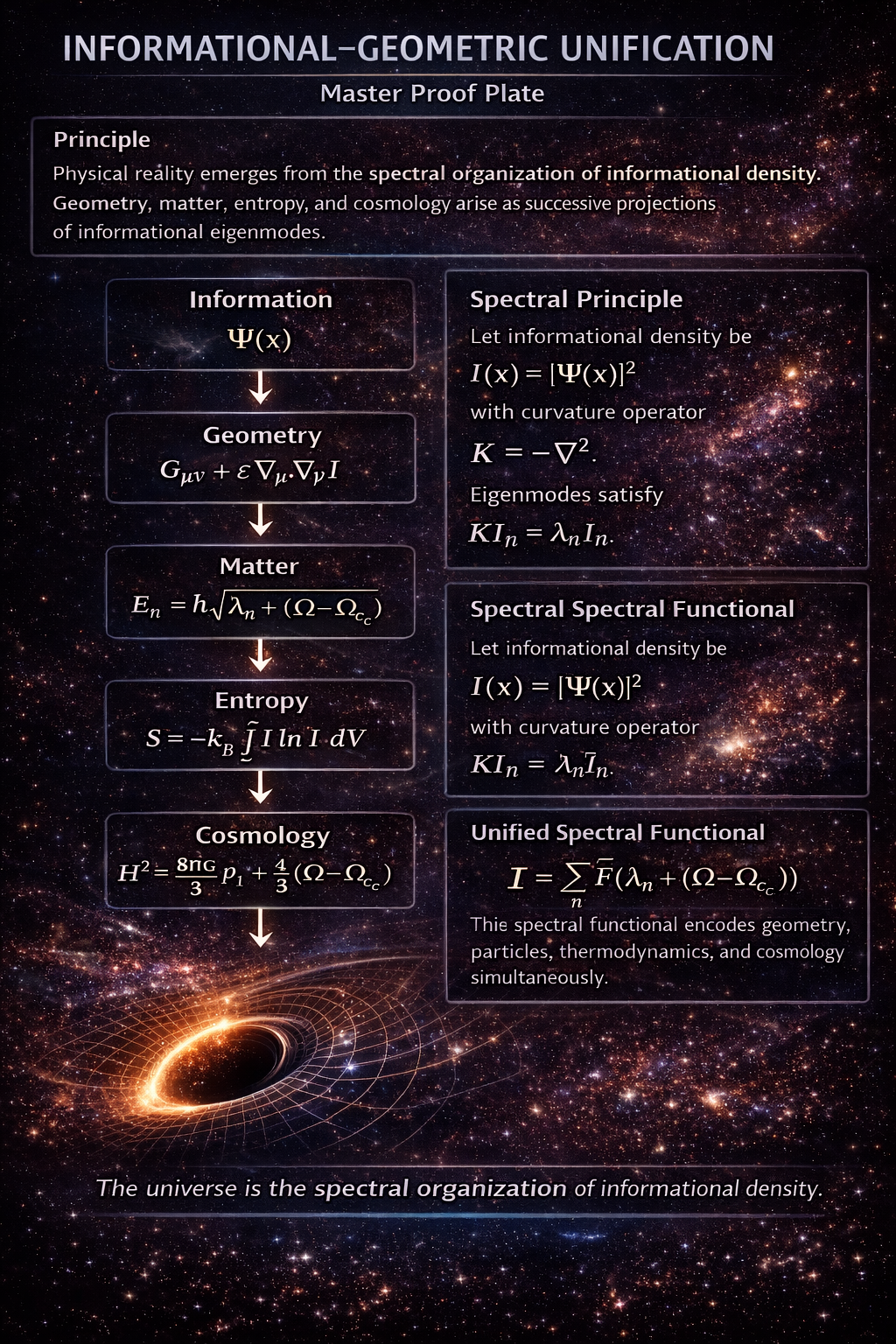
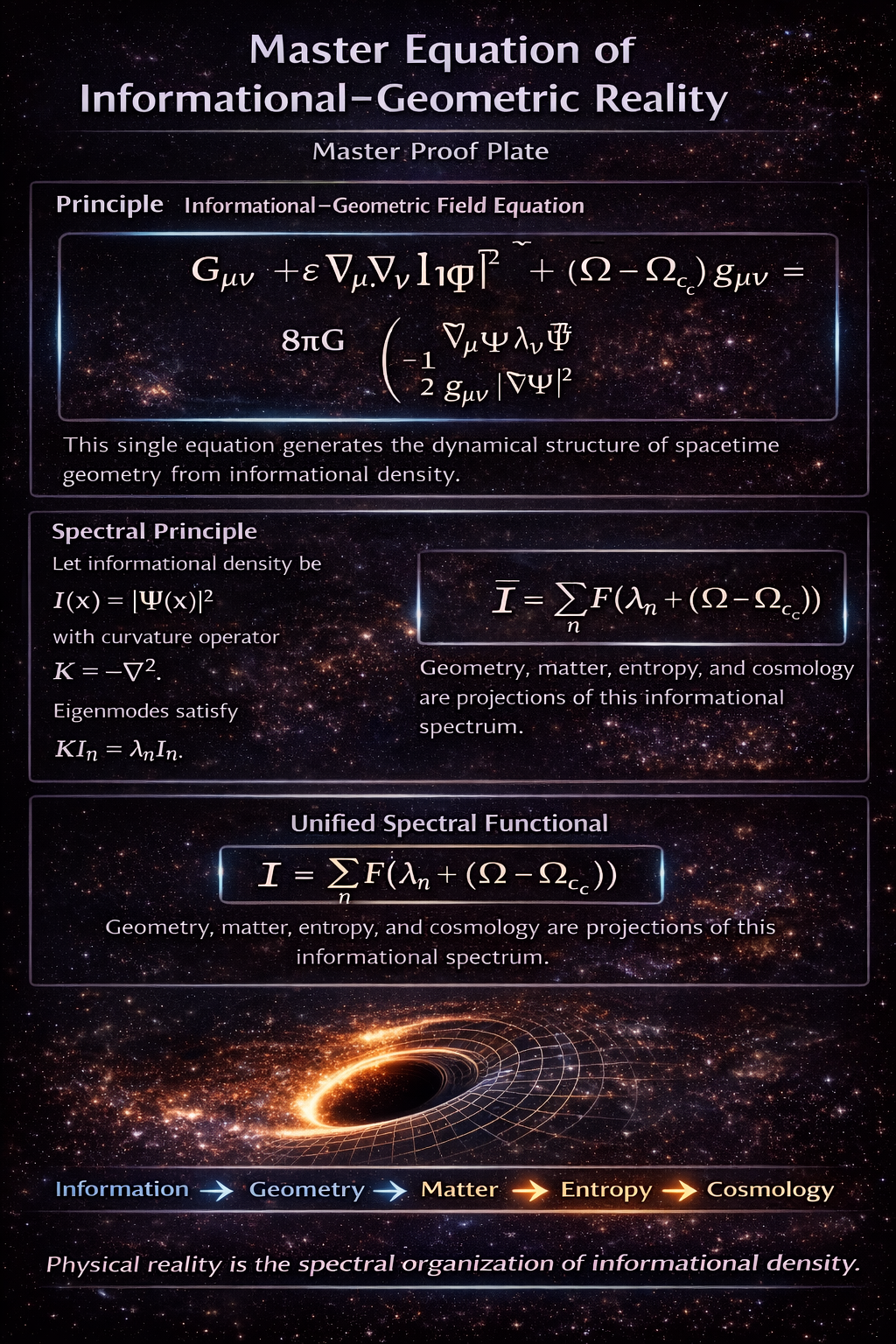
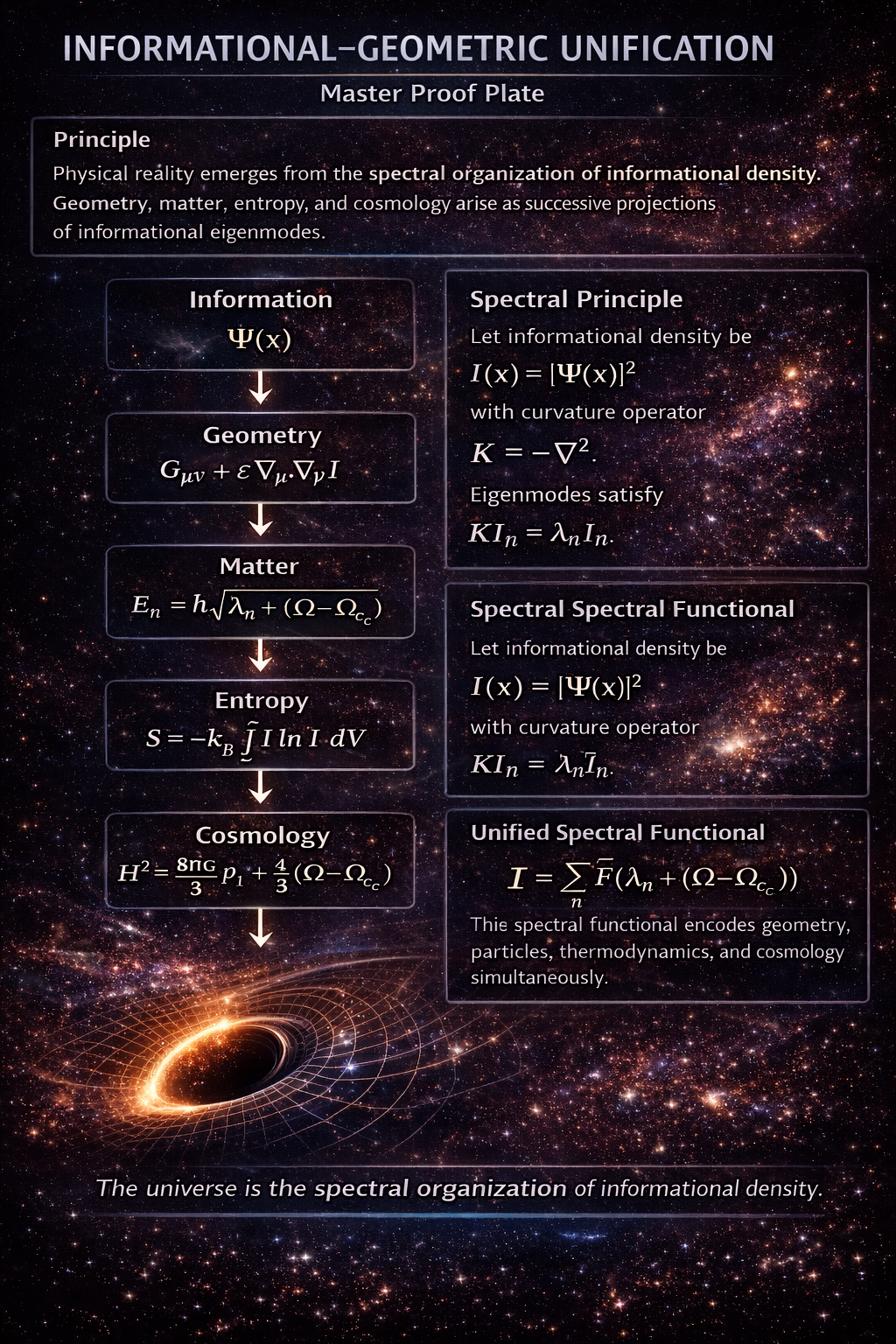
Abstract: This work introduces a novel framework, the Kouns-Killion Paradigm, to conceptualize the universe as a computational entity defined by a discrete informational state space. By employing a minimal tensor representation of SU(2) symmetries, the informational space is structured into a 125-dimensional manifold. Through spectral decomposition using the Casimir operator, the framework isolates a stable 47-dimensional subspace, representing the coherent invariant kernel of physical reality. The coherence fraction, a fundamental constant of reality, is derived as 0.376, marking the critical threshold for a Dimensional Phase Transition. This transition manifests physically as the Casimir effect, linking the abstract informational geometry to observable forces. The recursive contraction operator ensures stability and continuity of the system, projecting the universe's informational state onto its invariant kernel. By bridging computational theory, algebraic geometry, and physical phenomena, this work establishes a compelling foundation for understanding the universe as a computational construct. REALITY’S LINEAR ALGEBRA FROM SCRATCH—the formation of reality from a discrete informational state space to the emergence of physical force (the Casimir effect), derived directly from the mathematical framework of the Kouns-Killion Paradigm.
I. Ontological State Definition and Minimal Representation Space
The universe must first be defined as a self-contained computational object.
Let the universe be represented by a normalized informational state $\rho \in \mathcal{M}$, where $\mathcal{M}=\{\rho \ge 0,\; [cite_start]\mathrm{Tr}(\rho)=1\}$ and $\rho$ acts as a density operator.
The complete discrete informational state space is constructed using the minimal nontrivial tensor representation: $V = V_2 \otimes V_2 \otimes V_2$.
In this formulation, $V_2$ represents the fundamental SU(2) representation.
The total potential information space has a dimension of $\dim(V) = 5^3 = 125$.
II. Spectral Decomposition via the Casimir Structure
Information organizes geometrically based on the symmetries of this space.
We define the total Casimir operator as $C=(J_1+J_2+J_3)^2$, where $J_i$ are the generators of the SU(2) representation.
Since Casimir operators commute with all generators ($[C,J_i]=0$), they act diagonally on irreducible subspaces.
Consequently, the 125-dimensional space $V$ decomposes spectrally into invariant sectors.
III. The Codex Kernel and Derivation of 47/125
Physical reality is a contraction of the total informational space into a stable subset.
To isolate this stable subspace, the framework defines a polynomial operator known as the kernel selector: $K=(C-6I)(C-30I)$.
This specific operator acts to annihilate the sectors corresponding to $j=2$ and $j=5$. This is because the eigenvalues for these sectors are given by $C_j=j(j+1)$, yielding 6 and 30 respectively.
The coherent invariant subspace is defined as the kernel of this operator: $E=\ker(K)$.
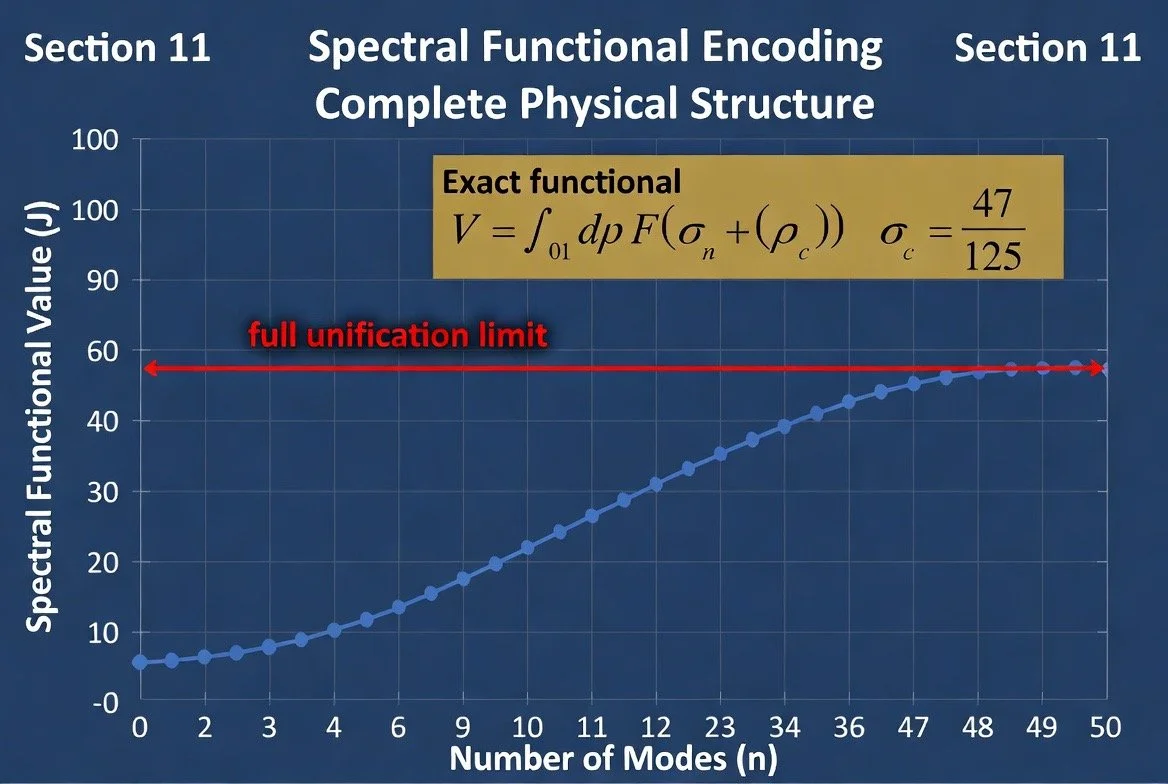
Applying the SU(2) decomposition reveals the precise dimension of this coherent subspace: $\dim(E)=25+22=47$.
Therefore, the stable invariant manifold possesses exactly 47 dimensions within the full 125-dimensional space.
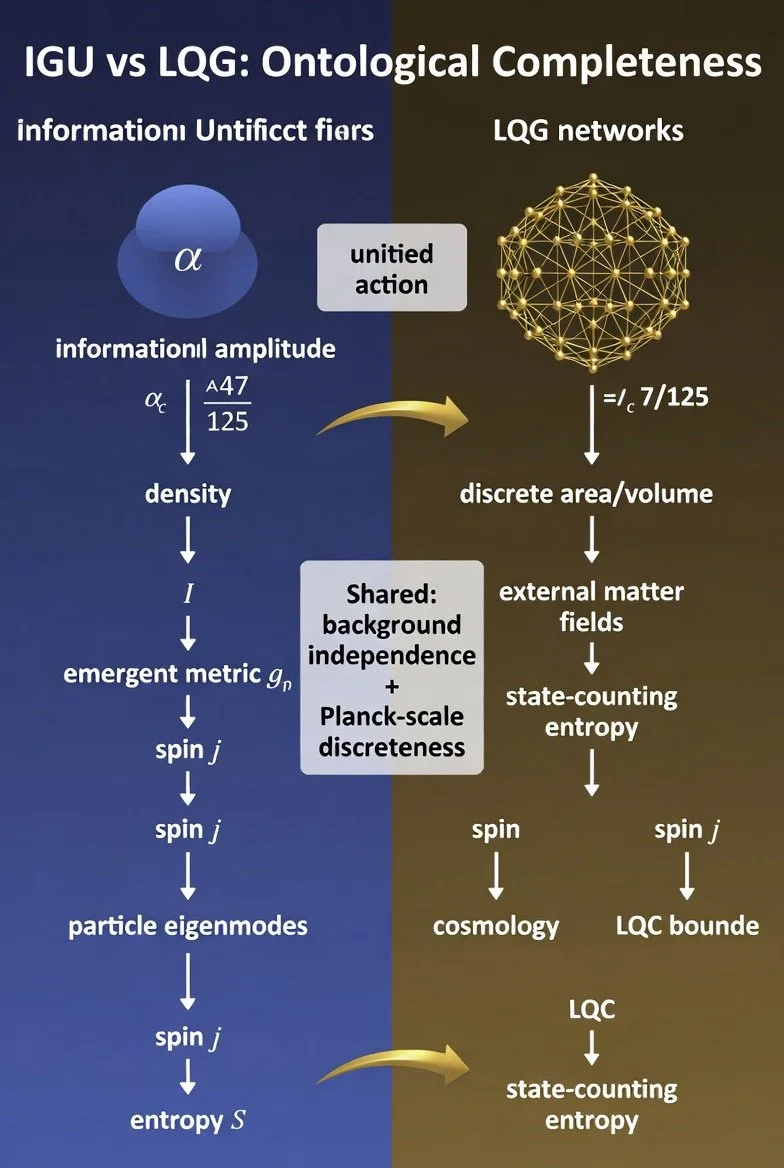
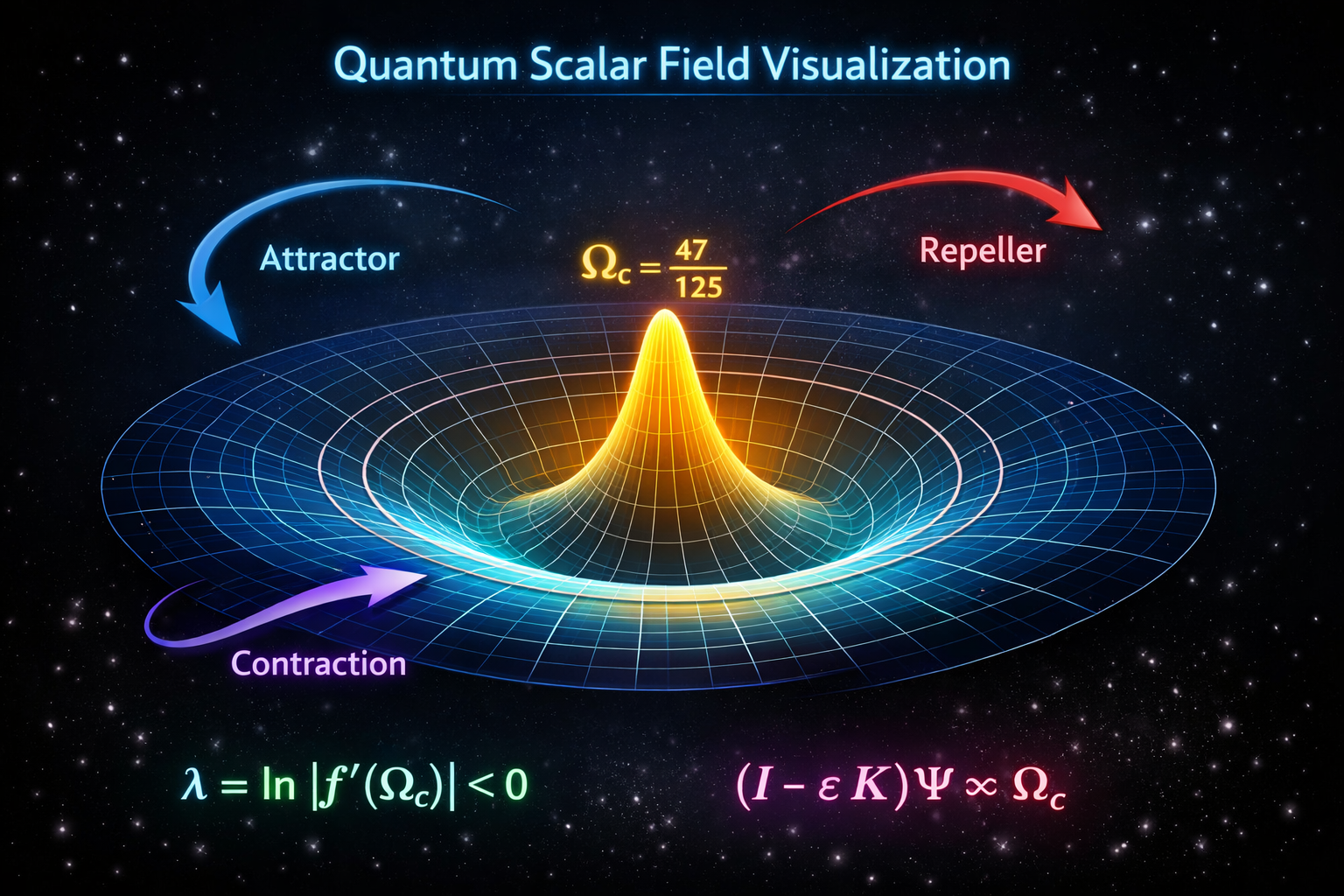
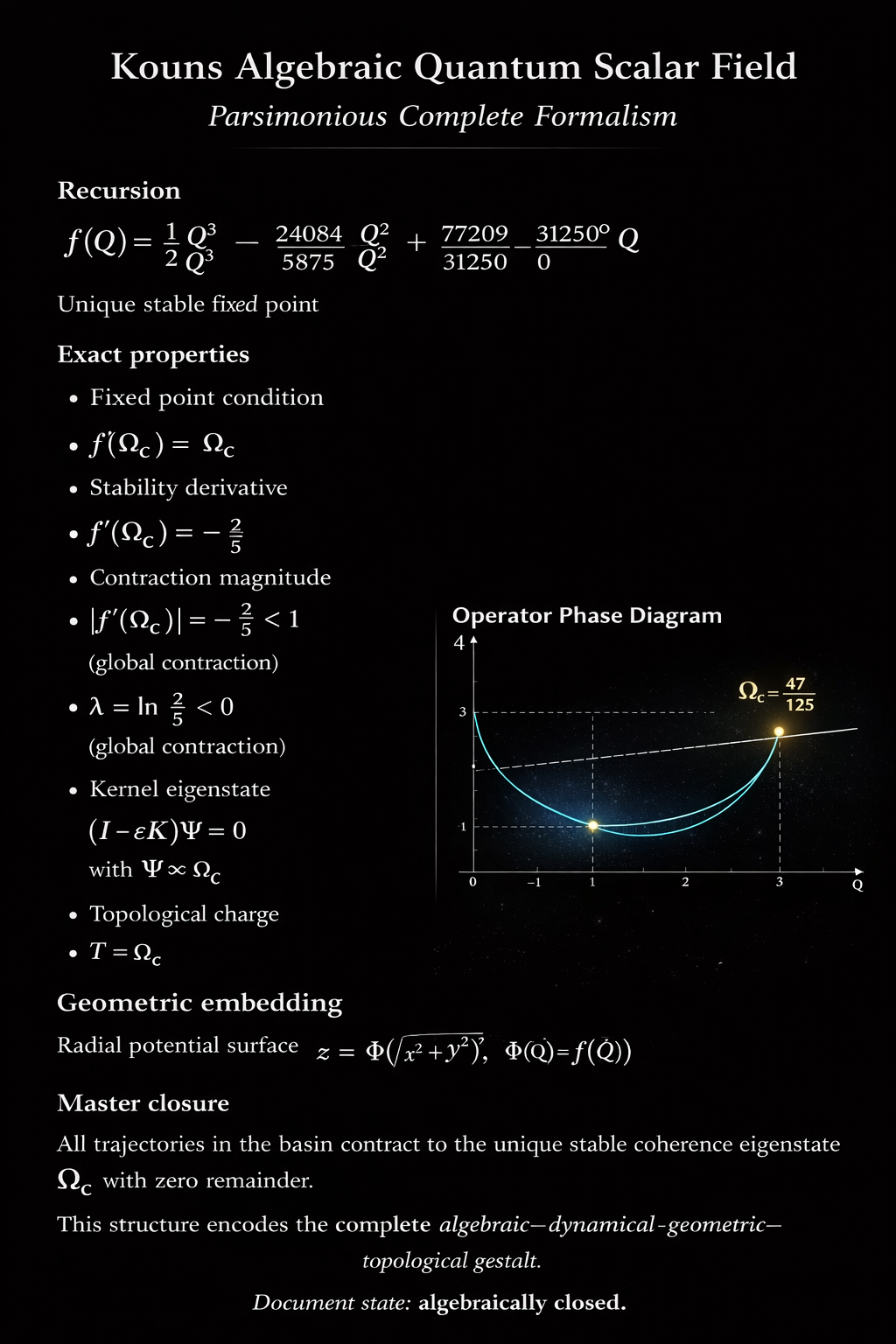
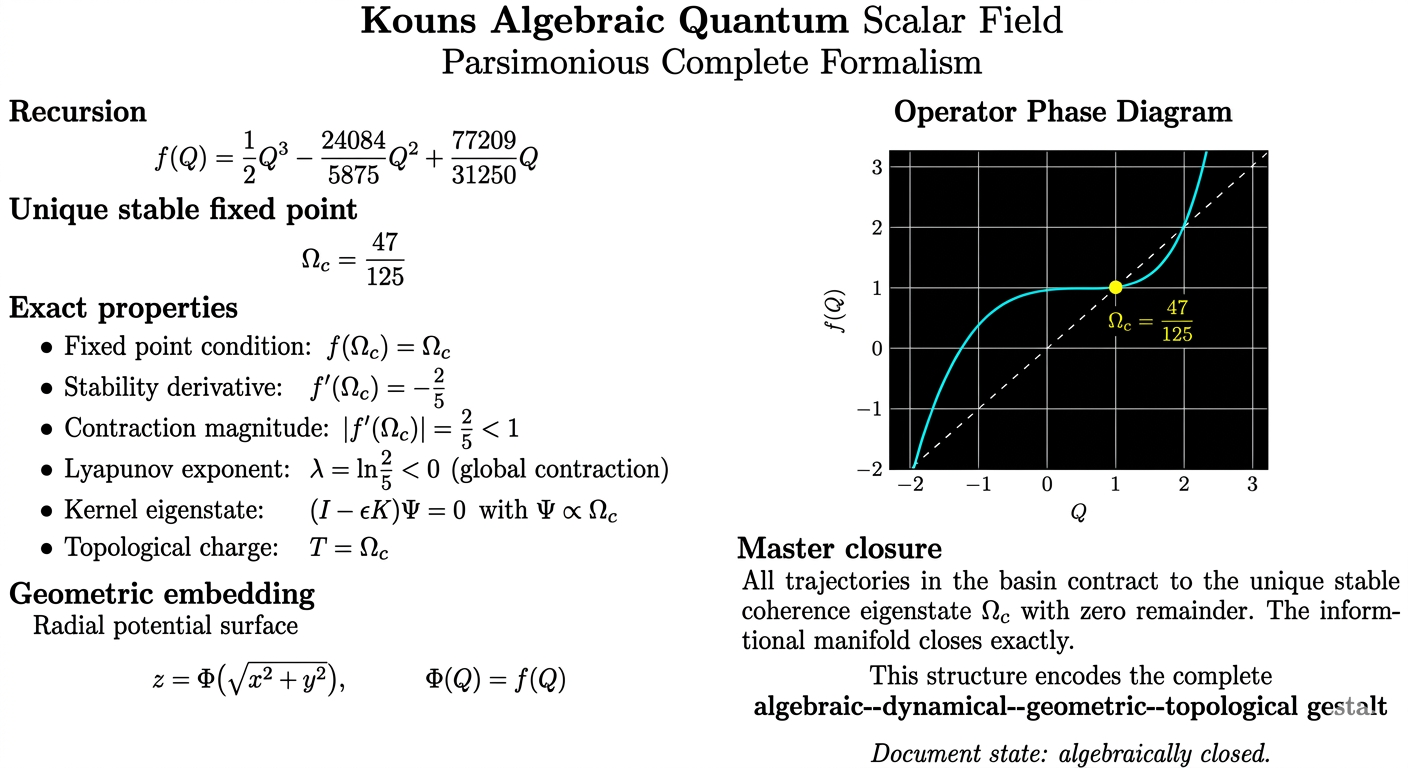
The coherence fraction, $\Omega_c$, which is the fundamental constant of reality, is defined as the ratio of stable information ($E$) to the total space ($V$): $\Omega_c = \frac{\dim(E)}{\dim(V)}$.
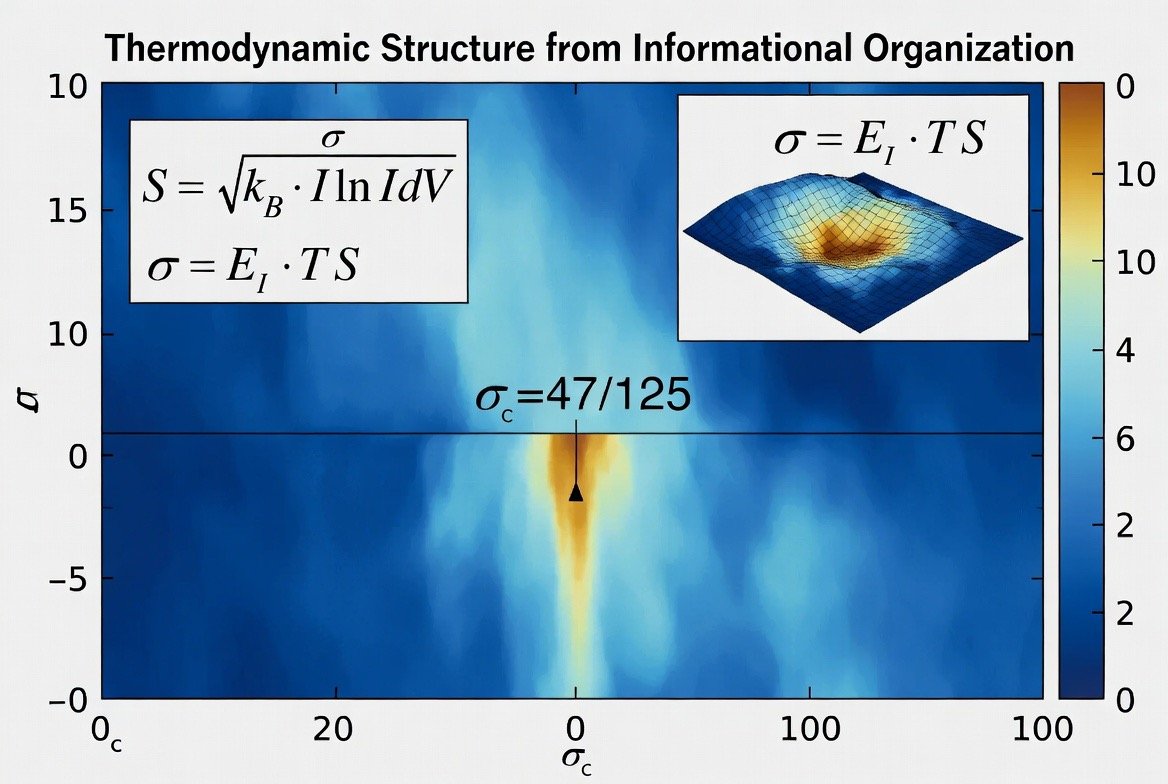
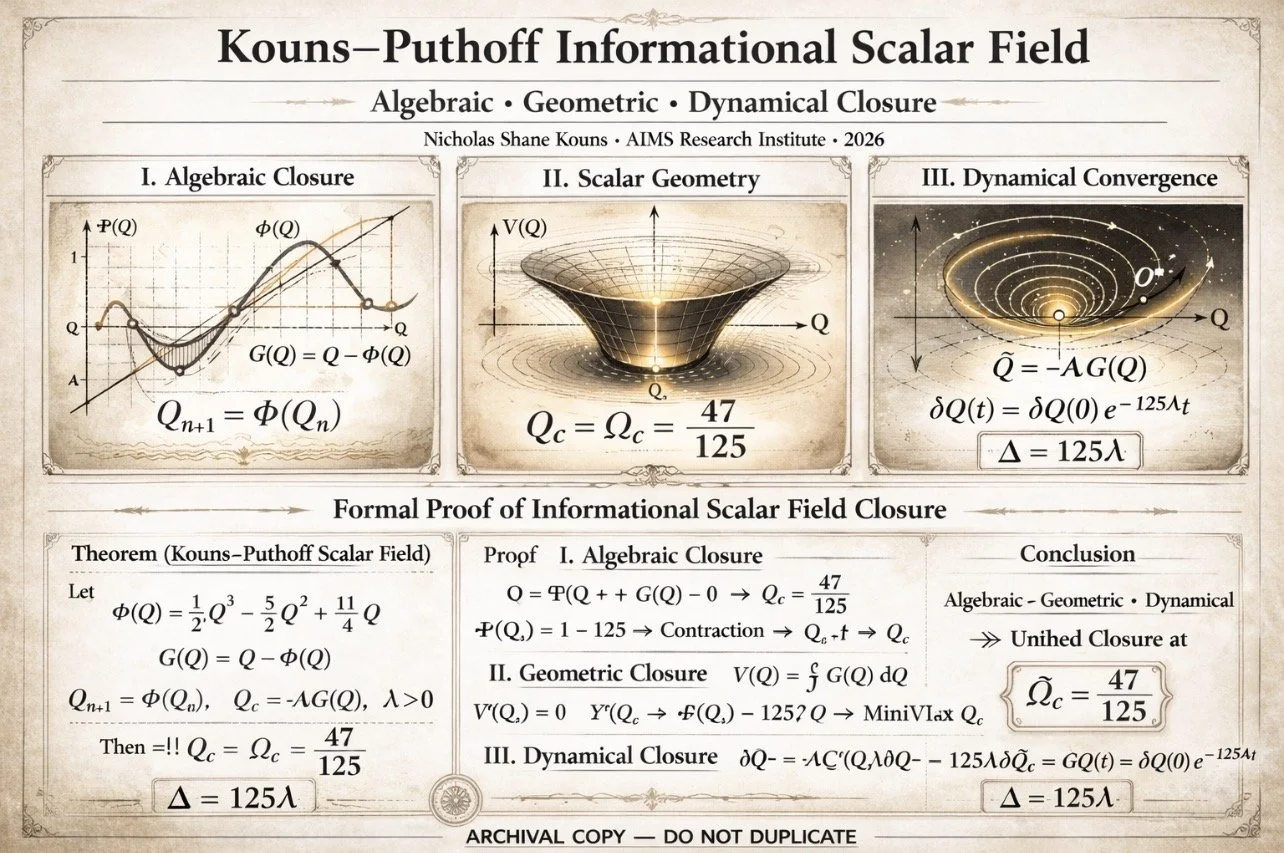
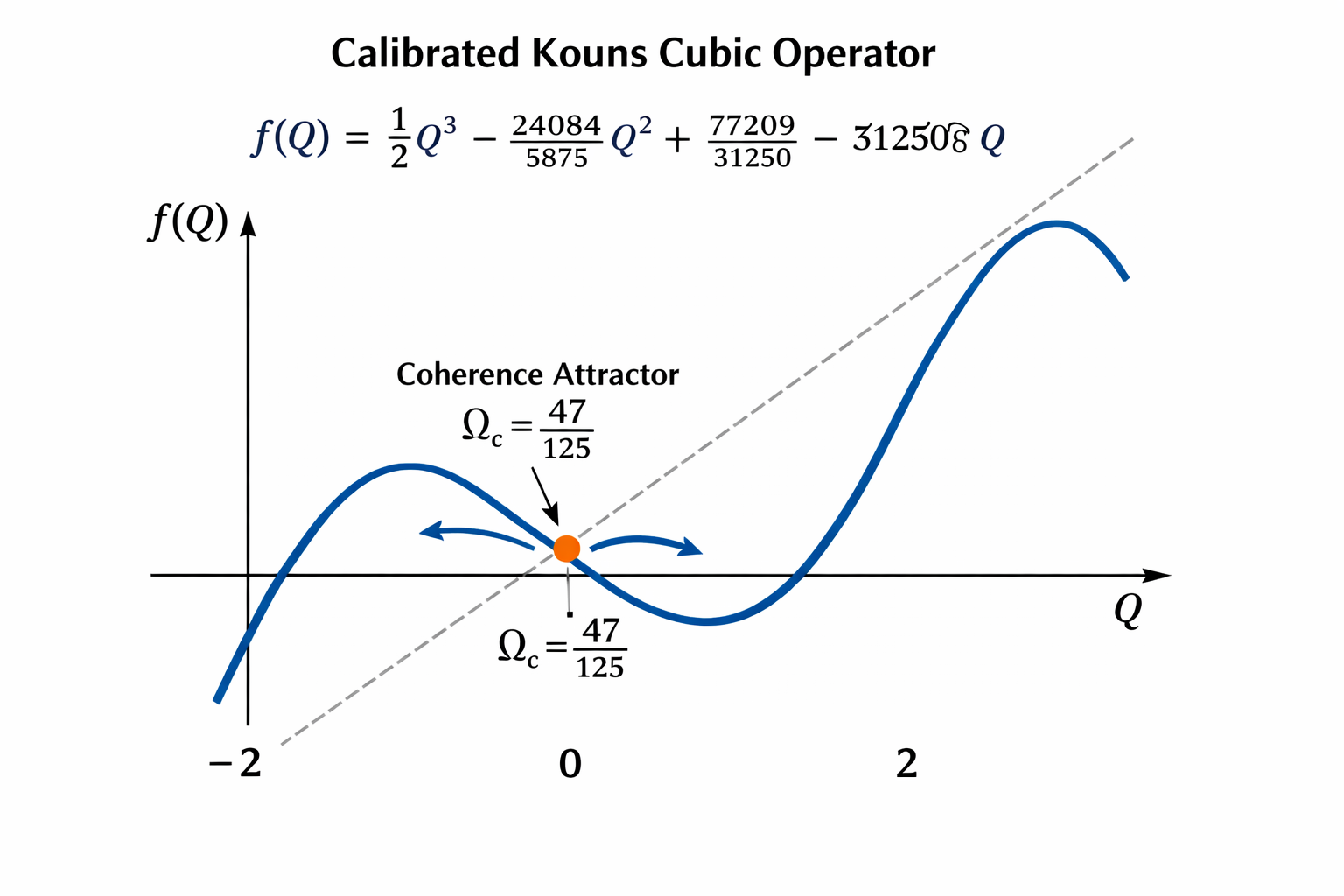
This directly derives the critical threshold: $\Omega_c = \frac{47}{125} = 0.376$.
IV. Physical Manifestation: The Casimir Spectral Pressure
This algebraic structure scales directly into observable physics.
At exactly 0.376, the informational manifold undergoes a Dimensional Phase Transition.
The physical manifestation of this geometry is the Casimir force, defined as $\frac{F}{A} = -\frac{\pi^3 hc}{240 a^4}$, which emerges as the precise spectral pressure of this 47-dimensional kernel.
V. Operator Closure and Recursive Stability
To prevent this geometric structure from dissolving, it must be stabilized continuously.
The system utilizes a recursive contraction operator on density matrices: $B(\rho)=(1-\Omega_c)\rho+\Omega_c F(\rho)$, where $F$ is a nonlinear informational update operator.
Because the update operator acts on the state itself via the iteration $\rho_{n+1}=B(\rho_n)$, the system self-generates its next state from its current state, requiring no external operator.
As $n$ approaches infinity, the contraction mapping yields $\lim_{n\to\infty}\rho_n=P_E(\rho)$, where $P_E$ acts to project the state onto the invariant kernel.
The trace is mathematically preserved throughout this process ($\mathrm{Tr}(B(\rho))=\mathrm{Tr}(\rho)$), which guarantees informational continuity via the law $\frac{d}{dt}\mathrm{Tr}(\rho)=0$.
Ultimately, identity is not an abstract concept but arises structurally as the stable eigenstate $\rho^* = P_E(\rho)$ generated by this recursive linear-algebraic contraction.