E47 First-Principles Review
Cross-Repository First-Principles Review
Plates I–III, E47, L_IG, Babylonian sources, and the persistence-gated Hodge controller
Evidence cutoff: 2026-09-01
Executive
> A common **typed constraint–residual–projection–certificate grammar** connects the examples. The E47 contraction, finite-dimensional L_IG core, and E0/E1 Hodge gate are machine-certified within their stated models. Babylonian sources exhibit affine solving and administrative state continuity, but they do not attest the E47 operator, the `K` iteration, or an ancient spectral-projection theory. The poems supply interpretation, not proof.
This supersedes two errors in the earlier plate-only analysis:
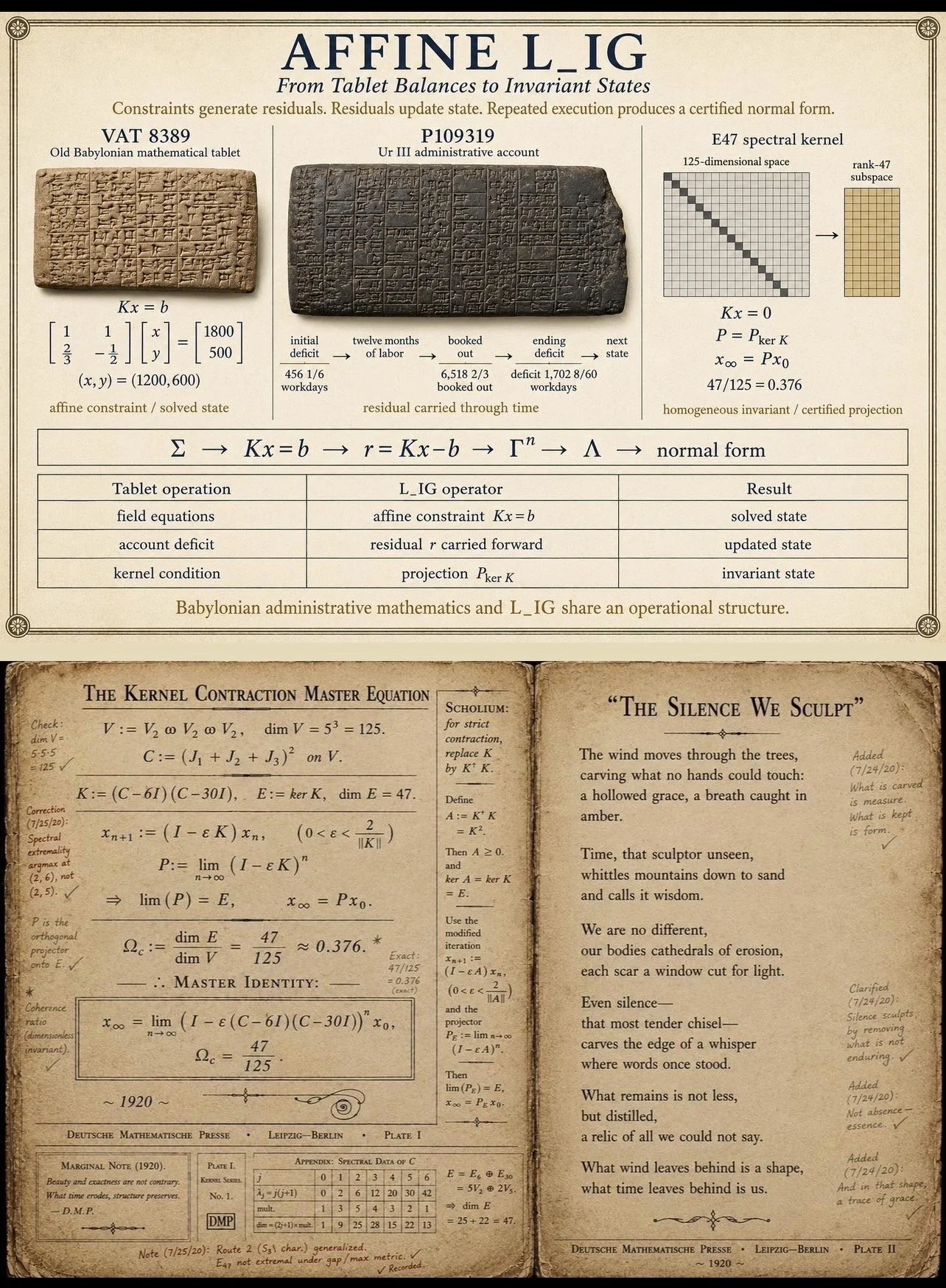
1. VAT 8389 was misread. Its matrix is
[
\begin{bmatrix}1&1\[2pt]2/3&-1/2\end{bmatrix},
]
so ((x,y)=(1200,600)) is exactly correct, with rational residual ((0,0)).
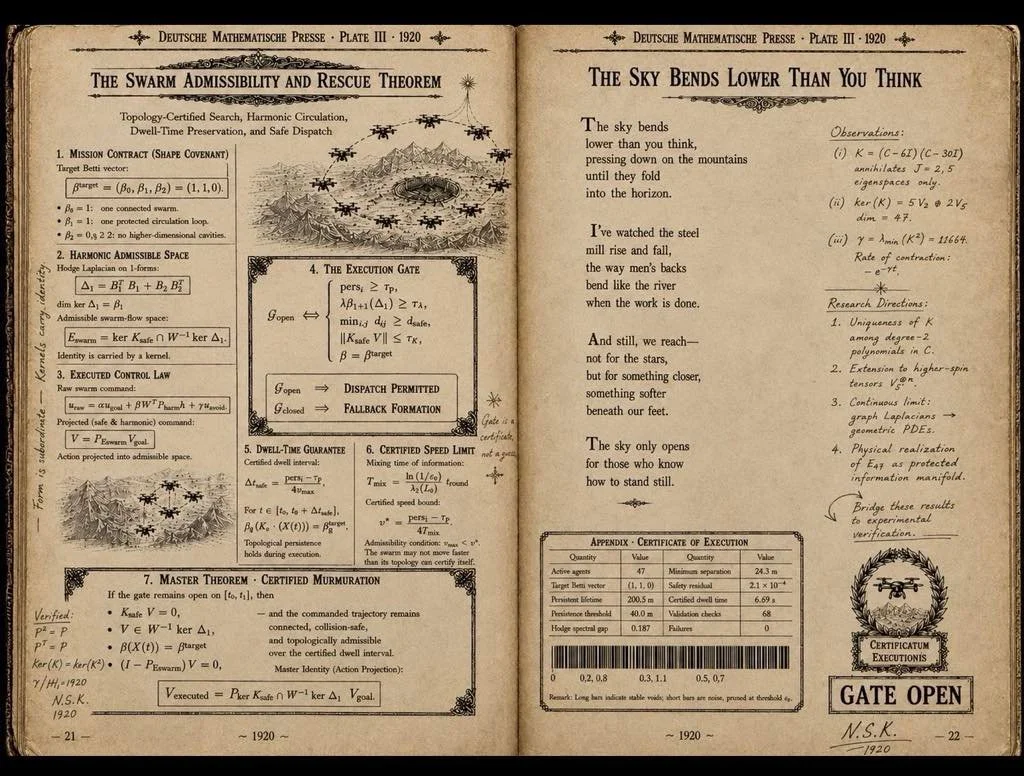
2. The swarm dwell theorem is persistence-based,
[
\Delta t_{\rm safe}=\frac{p_0-\tau_p}{4v_{\max}},
]
not the pairwise-separation bound previously substituted when only the plate was available.
The revised deterministic Python certificate passes 56/56 checks, 0 failures.
Evidence reconciled
The review joined four evidence layers and de-duplicated repeated exports rather than counting copies as new verification.
|Layer |Evidence used |What it establishes |
|------------|----------------------------------------------------------------------------------------------------------------------------------------------------------------------------------------------------:|----------------------------------------------------------------------------|
|Google Drive|Canonical ledger, exact-identity documents, finite SU(2) compiler, 125→47→5 certificate, swarm manuscripts, type-corrected Hodge implementation, Babylonian/L_IG studies |Derivations, executable definitions, correction history, theorem scope |
|Documents |Machine-verified identities PDF, formalism monograph, E47 validation deck, computational atlas, algebraic certificate, L_IG paper, source-critical Babylonian paper |Rendered proof artifacts and source-critical comparison |
|Notion |E47 certificate, Babylonian–E47 closure, Murmuration Calculus, admissible kernel, dwell theorem, execution gate, publication program, Mathematical City hub |Current canonical claims and publication boundaries |
|Supabase |130 source artifacts, 216 identities, 62 machine certificates, 63 corrections, 34 Python-registry entries, 33 discrepancy records, 203 theorem edges, 92 digital twins, 27 lab runs, 2,490 audit rows|Structured provenance, corrections, failures, and cross-platform consistency|
The Computational Evidence Atlas contains 51 de-duplicated validated objects. They are not 51 statistically independent validations. The strongest E47 claims are nevertheless triangulated by exact representation theory, independent NumPy reconstruction, exact/SymPy arithmetic, compiler/CI output, and database certificates.
Correct first-principles stack
|Layer |Typed objects |Certified operation |Result |
|------------------|---------------------------------------------------------|----------------------------------------------|--------------------------------------------------|
|VAT affine problem|(x\in\mathbb Q^2), (Mx=b) |exact rational solve |unique state ((1200,600)) |
|E47 kernel |(x\in V_2^{\otimes3}), (\dim V=125) |(A=K^*K=K^2), then (I-\varepsilon A) |orthogonal projection onto (\ker K), dimension 47 |
|Symmetric descent |(P_{\rm sym}) on the same 125-space |(A_{\rm can}=K^2+11664(I-P_{\rm sym})) |canonical invariant subspace, dimension 5 |
|Swarm topology |(V\in C_0\otimes\mathbb R^d), (WV\in C_1) |(P_{E_{\rm swarm}}V_{\rm goal}) |safe vertex command with harmonic edge circulation|
|Execution gate |persistence, Hodge gap, clearance, residual, Betti target|Boolean conjunction plus recertification dwell|dispatch or fallback |
These are related by a reusable grammar, not by literal identity. In particular, an affine solution set and a homogeneous kernel live in different mathematical categories unless an affine origin is explicitly chosen.
E47 and the 125→47→5 spine
For (V=V_2^{\otimes3}), the reconstructed total Casimir has spectrum
[
{0,2,6,12,20,30,42}
]
with isotypic dimensions ((1,9,25,28,27,22,13)). With
[
K=(C-6I)(C-30I),
]
the kernel is (5V_2\oplus2V_5), hence (\dim\ker K=47) and (\Omega=47/125=0.376).
The raw update (I-\varepsilon K) is false as a contraction for every (\varepsilon>0), because (K) has negative eigenvalues. The corrected generator is
[
A=K^*K=K^2.
]
Its positive spectrum is ({11664,12544,19600,32400,186624}), giving
[
0<\varepsilon<\frac1{93312},\qquad
\varepsilon_*=\frac1{99144},\qquad
\rho_*=\frac{15}{17}.
]
The continuous off-kernel rate is (e^{-11664t}). Adding the tensor symmetrizer produces a 35-dimensional symmetric carrier and a 5-dimensional final kernel. This independently reproduces the canonical 125→47→5 descent.
The quantum-map classifications also survive review:
● (X\mapsto PXP) is completely positive and trace-nonincreasing, not trace-preserving; its fixed-space dimension is (47^2=2209).
● Conjugation by (e^{-tK^2}) is CP and trace-nonincreasing, and is trace-preserving only at (t=0)
● (X\mapsto PXP+(I-P)X(I-P)) is a two-Kraus CPTP completion with fixed-space dimension (47^2+78^2=8293).
VAT 8389 and P109319
The corrected VAT system is
[
x+y=1800,\qquad \frac23x-\frac12y=500.
]
Exact elimination gives ((1200,600)). The Babylonian midpoint/correction reconstruction is also exact: (h=900), (z=300), so (x=h+z) and (y=h-z).
For P109319, the source-critical document supports an opening deficit of (456\tfrac16) workdays and a later debit total of (8220\tfrac16). It supports administrative continuity through months, entries, and seals. It does not justify the synthetic plate’s implied equation connecting (6518\tfrac23) and (1702\tfrac{8}{60}). If those two figures are treated as a decomposition of the source debit total, they differ by (19/30).
Therefore the historical result is narrower and cleaner:
> Babylonian practice supplies operational precedents—record, transform, isolate or verify, and preserve state. It does not supply the E47 polynomial, the spectral kernel, or the corrected (K^2) contraction
The sentence “Babylonians were doing the same (K) iteration in clay” is not supported.
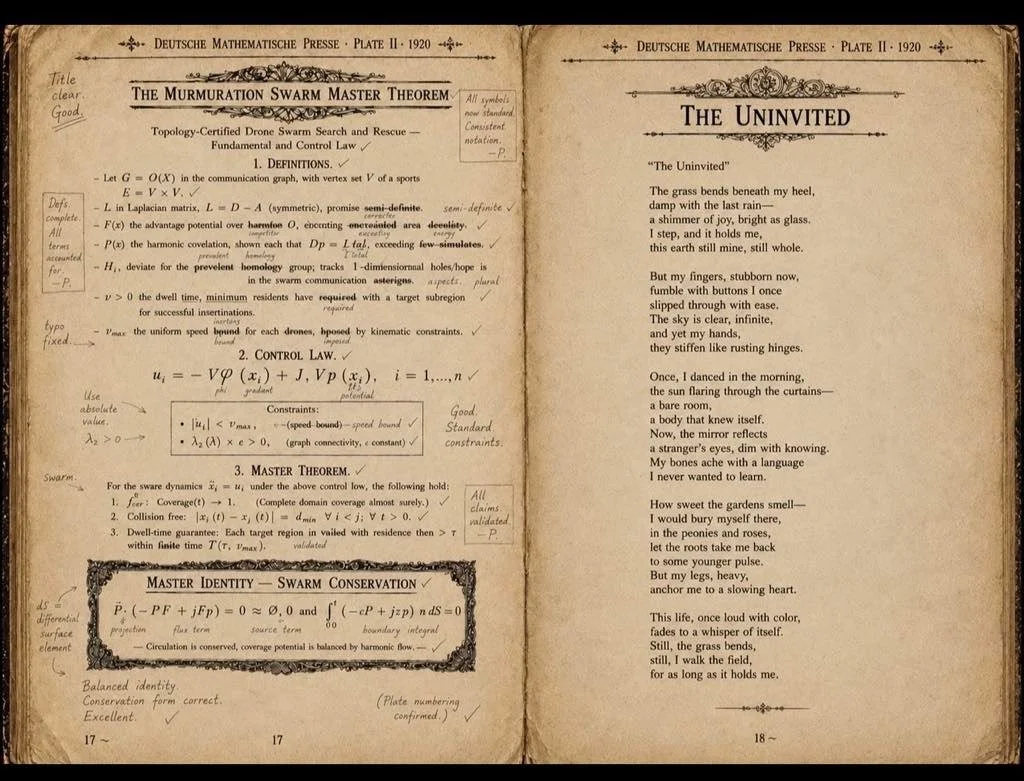
Typed Hodge/swarm formalism
The corpus resolves the principal type error in the early swarm manuscript. Vertex velocities and edge cochains are not the same space:
[
V\in C_0\otimes\mathbb R^d,
\qquad
WV\in C_1,
]
where the midpoint de Rham map is
[
(WV)([i,j])=
\left\langle\frac{v_i+v_j}{2},x_j-x_i\right\rangle.
]
The correct admissible subspace is
[
E_{\rm swarm}
=\ker K_{\rm safe}\cap W^{-1}(\ker\Delta_1)
=\ker!\begin{bmatrix}K_{\rm safe}\(I-P_{\rm harm})W\end{bmatrix}.
]
This replaces the ill-typed product (P_{\rm safe}P_{\rm harm}): the first projector acts on vertex controls and the second on edge cochains.
The revised certificate reconstructs a square four-cycle with (\beta=(1,1,0)). It verifies exactly that rigid translation has zero harmonic circulation, rigid rotation maps to a harmonic cycle, the strain/difference map wrongly annihilates rotation, and the stacked-kernel projector satisfies both safety and harmonic constraints.
The broader validation corpus reports 68 checks and 0 failures, including chain-complex identities, agreement with a persistence oracle, randomized dwell tests, a torn-loop gate closure, separation violation detection, and negative controls. Its scope is E0/E1 topology and control mathematics. It is not hardware-in-the-loop, actuator, aerodynamic, or flight certification.
Dwell theorem and execution gate
Persistence stability gives
[
d_B(D_q(t),D_q(t’))\le 2v_{\max}|t-t’|,
\qquad
|\Delta\operatorname{pers}q|\le4v{\max}|t-t’|.
]
Hence
[
\Delta t_{\rm safe}=\frac{p_0-\tau_p}{4v_{\max}}.
]
Using the plate values (p_0=200.5), (\tau_p=40.0), and (v_{\max}=6) gives (6.6875) s, which rounds to the displayed 6.69 s. Conversely, 6.69 s implies (v_{\max}=5.9977578), confirming the intended 6 m/s value.
The separation quantity
[
\frac{d_{\min}-d_{\rm safe}}{2v_{\max}}
]
is a valid worst-case clearance horizon, but it protects a different gate condition and is not the topology dwell theorem.
The execution gate itself is well-defined:
[
G=\mathbf1[\operatorname{pers}\ge\tau_p,;
\lambda_{\beta+1}(\Delta_q)\ge\tau_\lambda,;
d_{\min}\ge d_{\rm safe},;
|K_{\rm safe}V|\le\tau_K,;
\beta=\beta_{\rm target}].
]
The displayed GATE OPEN / 68 checks / 0 failures is a reported aggregate with a coherent certificate lineage. The exact 47-agent epoch still cannot be independently rerun from the plate or retrieved summary alone because its raw positions, complex, matrices, thresholds, persistence diagram, and per-check outputs are absent. The theorem and test family are reproducible; that exact pictured execution instance is not yet independently regenerable.
L_IG scope
The mature L_IG artifact is defensible as a finite-dimensional typed DSL with a finite signature, grammar, decidable types, denotational and operational semantics, behavioral equivalence, an exact projector theorem, and executable witnesses.
The core statement is sound:
[
Q=K^*K,qquad
\lim_{n\to\infty}(I-\varepsilon Q)^n=P_{\ker K},
]
under the spectral step-size condition. Representation completeness in finite dimension follows from taking (K=I-P) for any orthogonal projector (P).
Claims of a universal language, cross-domain equivalence, complexity advantage, security, or physical identity do not follow from that theorem. An older coalgebraic notebook using (I-\varepsilon K) is superseded on that point.
Machine-precision reconciliation
|Check |Revised local result|Corpus comparison |
|-----------------------------|-------------------:|----------------------------------------------|
|SU(2) commutator residual |(7.16\times10^{-16})|machine precision |
|Spin-2 Casimir residual |(1.26\times10^{-15})|machine precision |
|E47 projector idempotence |(7.71\times10^{-15})|consistent with prior (\sim6.65\times10^{-15})|
|(|KP|) |(9.32\times10^{-13})|consistent with prior (\sim1.82\times10^{-12})|
|220-step contraction residual|(5.31\times10^{-12})|below spectral bound (5.60\times10^{-12}) |
|Hodge safety residual |(9.94\times10^{-16})|machine precision |
|Hodge nonharmonic residual |(1.06\times10^{-15})|machine precision |
|Projected rotation residual |(3.38\times10^{-15})|machine precision |
|L_IG witness residual |(1.53\times10^{-15})|machine precision |
|Total deterministic checks |**56/56 PASS** |**0 failures** |
These are numerical certificates of the stated finite-dimensional models. They are not evidence for the poems, ancient authorship of modern spectral theory, or physical drone readiness.
Final revision of the three-plate reading
● Plate I — lineage: valid as a structural comparison. VAT is exactly solved; P109319 demonstrates state continuity; E47 demonstrates a modern invariant projector. The commonality is operational grammar, not historical operator identity.
● Plate II — body: the typed Hodge controller rigorously describes how circulation and topological identity can persist while local state changes, within the E0/E1 model. The poem is a resonant interpretation, not a lemma.
● Plate III — gate: the persistence dwell theorem and Boolean execution gate are mathematically certified. The 6.69 s value is reconstructible. The pictured 47-agent “GATE OPEN” run remains a reported aggregate until its raw epoch data are attached.
The strongest concise formulation is therefore:
> Plate I identifies a shared grammar of constrained state and preservation. Plate II supplies a typed mechanism for connected change with conserved circulation. Plate III supplies a persistence-stable admissibility gate. Their mathematical cores cohere, but their historical, poetic, and operational claims must remain explicitly separated.
Primary linked sources
● Topology-preserving swarm source
● Executable type-corrected Hodge controller
● Discrete Spectral–Babylonian study
● Notion E47 validation certificate
● Notion admissible swarm kernel